

Parallel Lines & Transversals

Presentation
•
Mathematics
•
8th Grade
•
Practice Problem
•
Medium
+1
Standards-aligned

Erika Dean
Used 244+ times
FREE Resource
19 Slides • 22 Questions
1
Parallel Lines & Transversals

2
Parallel Lines
Remember, PARALLEL LINES are lines that lie in the same plane and do not intersect.

3
Transversal
A TRANSVERSAL is a line that intersects two or more lines at distinct points.

4
Parallel Lines & Transversals
When a TRANSVERSAL intersects PARALLEL LINES, 8 angles are formed.
These angles have special realtionships that are helpful to remember.

5
Multiple Choice
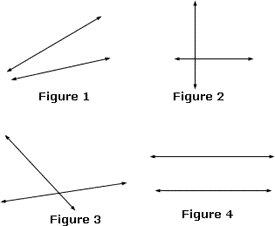
Which figure shows a set of parallel lines?
6
Multiple Choice

True or False: This figure shows a picture of a transversal.
7
8
Corresponding Angles
Just like corresponding parts of similar figures, CORRESPONDING ANGLES are in the same position on each parallel line.
These angle pairs are CONGRUENT.

9
Vertical Angles
VERTICAL ANGLES are pairs of opposite angles formed by intersecting lines.
These angle pairs are CONGRUENT.

10
Multiple Choice

What angle corresponds to ?
11
Multiple Choice
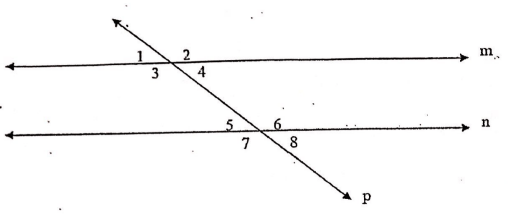
Which angles are vertical angles?
12
Interior vs. Exterior
Angles in between the parallel lines are called INTERIOR ANGLES.
Angles that are outside of the parallel lines are EXTERIOR ANGLES.

13
Consecutive vs. Alternate
CONSECUTIVE angles are on the SAME SIDE of the transversal.
ALTERNATE angles are on OPPOSITE SIDES of the transversal.

14
Consecutive Interior Angles
Angles on the SAME SIDE of the transversal and INSIDE of the parallel lines.
These angles are SUPPLEMENTARY ANGLES.
15
Consecutive Exterior Angles
Angles on the SAME SIDE of the transversal and OUTSIDE of the parallel lines.
These angles are SUPPLEMENTARY ANGLES.

16
Alternate Interior Angles
Angles on the OPPOSITE SIDES of the transversal and INSIDE of the parallel lines.
These angles are CONGRUENT.

17
Alternate Exterior Angles
Angles on the OPPOSITE SIDES of the transversal and OUTSIDE of the parallel lines.
These angles are CONGRUENT.

18
Multiple Choice

∠3 and ∠6 are...
19
Multiple Choice

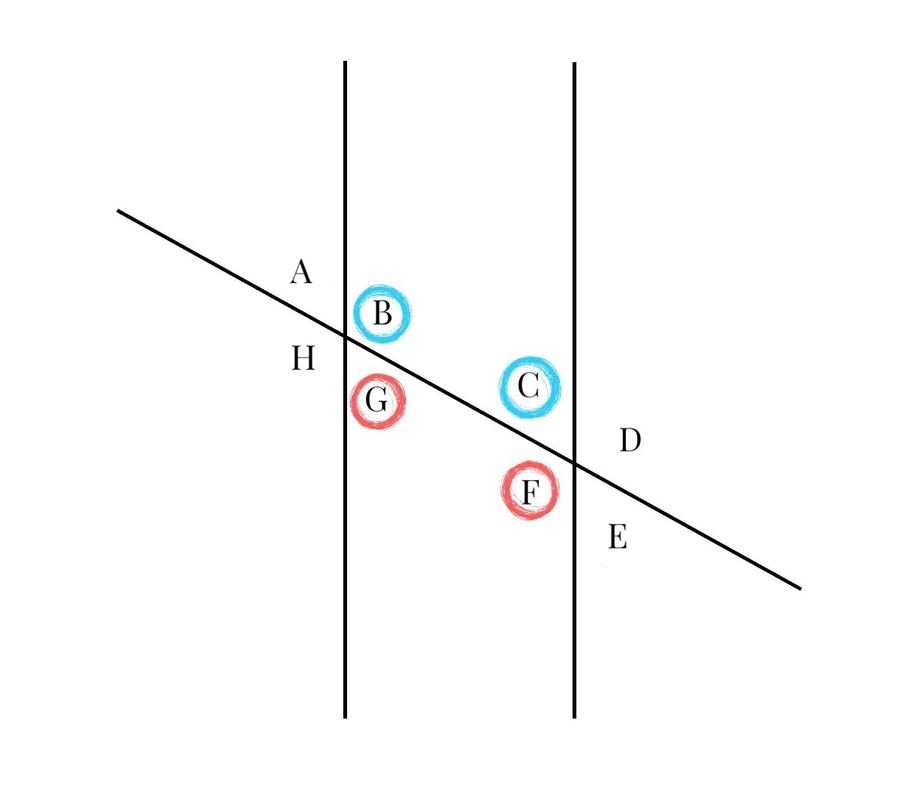
Angle B and Angle R are...
20
Multiple Choice

Angle C and Angle P are...
21
Multiple Choice

Name the consecutive exterior interior angle to angle 1.
22

We can use the relationships of these angle pairs to find the measure of missing angles.
23
Multiple Choice
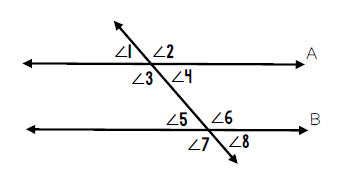
If the find the measure of ?
24
Multiple Choice

Find y.
25
Multiple Choice

Find the value of x.
26
Multiple Choice

What is the measure of ∠6?
27
Multiple Choice

What is the measure of ∠1?
28
Multiple Choice

What is the measure of ?
29
30
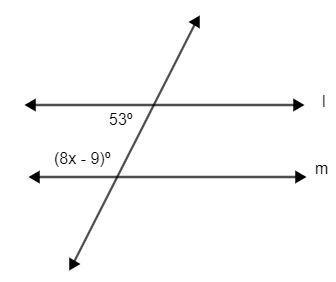
Step 1: Identify the type of angle & relationship
These are consecutive interior angles. They are supplementary, so adding them together equals .
31
Step 2: Write the equation to solve.

32
Step 3: Solve the equation

33
Step 4: Check your answer
Don't forget that you can plug your answer back into the original figure/equation to check if it is correct.

34
Multiple Choice
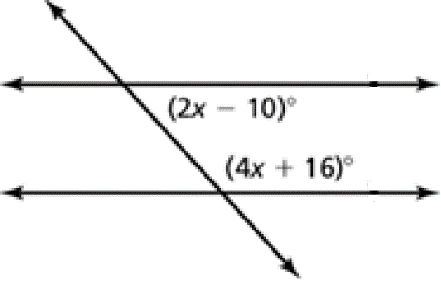
Which is the correct equation to solve for x?
35
Multiple Choice
Now, find the value of x.
36
Multiple Choice

Which of the following equations can be used to find the value of x?
37
Multiple Choice

Now solve for the value of x?
38
Multiple Choice

Which equation can be used to solve for x?
39
Multiple Choice
What is the value of x?
40
Multiple Choice
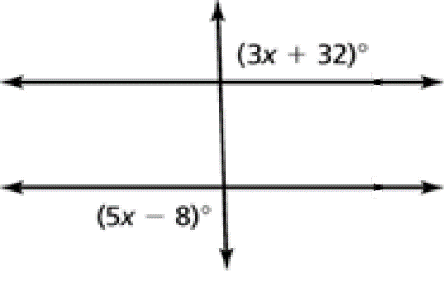
Which is the correct equation to solve for x?
41
Multiple Choice
Now, what is the value of x?
Parallel Lines & Transversals
Show answer
Auto Play
Slide 1 / 41
SLIDE

