

Isomers

Presentation
•
Chemistry
•
11th Grade
•
Practice Problem
•
Medium

Mr. Cavida
Used 37+ times
FREE Resource
13 Slides • 19 Questions
1
Isomers

2
Multiple Choice
3
Multiple Choice
4
Multiple Choice
5
Multiple Choice
6
Multiple Choice
7
Multiple Choice

Given the structural formulas:
Which two formulas represent compounds that are isomers of each other?
8
Multiple Choice

Given a formula representing a compound:Which formula represents an isomer of this compound?
9
Multiple Choice
10
What is isomerism?
Isomers are molecules with the same molecular formula (i.e. the same number and type of atoms) but in which the atoms are arranged in a different way.

11
Two main types of isomerism
Structural isomers have different structural formulae. Three types of structural isomerism are chain isomerism, positional isomerism and functional group isomerism.
Stereoisomers have the same structural formula, but the 3D arrangement of atoms is different (enantiomers). Two types are cis–trans isomerism and optical isomerism.

12
Chain isomerism
In chain isomers, the carbon chain is arranged differently.
For example, hexane has several chain isomers, all with the molecular formula C6H14:

13
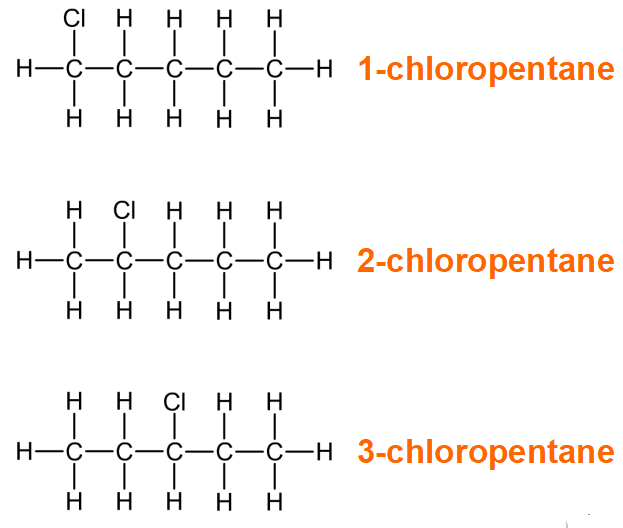
Positional isomerism
In positional isomers, the functional group is attached to a different carbon atom.
For example, chloropentane has several positional isomers, all with the molecular formula C5H11Cl:
14
Positional isomerism
Positional isomerism also exists in alkenes with four or more carbon atoms.
For example, hexene has several positional isomers, all with the molecular formula C6H12:

15
Functional group isomerism
Functional group isomers contain different functional groups and so are members of different homologous series.
For example, both alcohols and ethers have the general formula CnH2n+2O so they may be functional group isomers:

16
Multiple Choice

17
Multiple Choice

18
Multiple Choice

19
Multiple Choice

20
Multiple Choice

21
Cis–Trans isomerism
Molecules can rotate freely around single C-C covalent bonds, but not around C=C double bonds.
Isomers differ in the arrangement of the groups attached to the carbons in the double bonds.
These isomers cannot be superimposed on each other because the arrangement of the methyl groups is different.

22
Cis–Trans isomerism
If an alkyl group or atom other than hydrogen is attached to each carbon then the isomers can be named either cis (‘on the same side’) or trans (‘on the opposite side’).

23
Limitations of cis–trans isomerism
For example, is it possible to identify which of these halogenoalkanes is the cis isomer and which is the trans isomer?
Instead, a different system is used for these type of molecules: E–Z notation.

24
Limitations of cis–trans isomerism
In more complex organic compounds, in which multiple hydrogens have been substituted by different groups, isomers cannot be defined using the cis–trans notation.

25
26
Optical isomerism
A molecule can exist as two isomers that are non-superimposable, mirror images of each other, just like a left hand and right hand.
Optical isomers have the same physical properties, but they rotate polarized light in opposite directions.

27
Multiple Choice
28
Multiple Choice
29
Multiple Choice
30
Multiple Choice
31
Multiple Choice
32
Open Ended
Isomers
Show answer
Auto Play
Slide 1 / 32
SLIDE

