
Review and Moon
Presentation
•
Science
•
8th Grade
•
Medium
Rebecca Smith
Used 6+ times
FREE Resource
13 Slides • 52 Questions
1
Review and Moon
2
Part 1: Atoms
3
Atoms - Smallest Part of Matter
Electron: Positive, NUCLEUS
Neutron: No charge (neutral), NUCLEUS
Electron: Negative, ELECTRON CLOUD
4
Multiple Select
Which TWO of the following subatomic particles are inside the nucleus?
protons
electrons
neutrons
There are no subatomic particles in the nucleus of an atom.
5
Multiple Choice
Why is the overall charge of an atom neutral (0)?
They have the same number of protons and neutrons.
They have the same number of protons and electrons.
They have the same number of electrons and neutrons.
6
Multiple Choice
Which subatomic particle has a neutral (0) charge?
proton
nuetron
electron
atom
7
Multiple Choice
Which subatomic particle has a negative charge?
proton
neutron
electron
atom
8
Multiple Choice
Which subatomic particle has a positive charge?
proton
nuetron
electron
atom
9
Multiple Choice
The smallest particle into which an element can be divided and still be the same element is a(n)
proton
neutron
electron
atom
10
Atoms
Atomic Number = Number of Protons
Atomic Mass = Protons + Neutrons
Neutrons = Atomic Mass - Atomic Number
11
Fill in the Blanks
Type answer...
12
Fill in the Blanks
Type answer...
13
Multiple Choice
How many protons does Helium (He) have?
1
2
3
4
14
Multiple Choice
What does the 40.08 stand for in the Calcium block?
Atomic number
Atomic weight
Atomic symbol
15
Multiple Choice
What does the K stand for in the Potassium block?
Atomic number
Atomic weight
Symbol for the atom
16
Multiple Choice
What does the number 11 stand for in the Sodium block?
atomic number
atomic weight
Stranger Things
17
Multiple Choice
What is the chemical symbol of this element?
79
Au
AU
gold
18
Multiple Choice
What is the mass number of this element?
7
8
14
14.01
19
Multiple Choice
20
Multiple Choice
21
Multiple Choice
22
Atoms
Identity - Protons (ATOMIC NUMBER)
Reactivity - Valenvce Electrons
Outside energy level electrons
23
ATOMS - VALENCE ELECTRONS
Atoms WANT 8
24
Multiple Choice
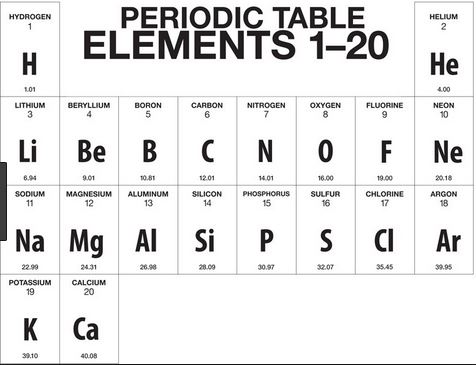
How many valence electrons does Potassium Have?
1 Valence electron
2 Valence electron
3 Valence electron
4 Valence electron
5 Valence electron
25
Multiple Choice
How many valence electrons does Phosphorus Have?
1 Valence electron
2 Valence electron
3 Valence electron
4 Valence electron
5 Valence electron
26
Multiple Choice
How many valence electrons does Magnesium Have?
1 Valence electron
2 Valence electron
3 Valence electron
4 Valence electron
5 Valence electron
27
Multiple Choice
How many valence electrons does Helium Have?
1 Valence electron
2 Valence electron
3 Valence electron
4 Valence electron
5 Valence electron
28
Multiple Choice
How many valence electrons does Hydrogen Have?
1 Valence electron
2 Valence electron
3 Valence electron
4 Valence electron
5 Valence electron
29
Counting Atoms
Coefficient - BIG NUMBER IN THE FRONT - MULTIPLY THROUGH
Subscript - small number to the right of a SYMBOL or PARENTHESES - ONLY APPLIES TO THE THING TO THE LEFT OF IT.
30
Multiple Choice
How many atoms are there TOTAL in H2SO4 ?
6
5
7
3
31
Multiple Choice
32
Multiple Choice
How many Magnesium atoms are in 10MgCl2?
10
5
20
33
Multiple Choice
How many Oxygen atoms are in H2O?
1
2
0
4
34
Multiple Choice
How many Hydrogen atoms are in 4H2O?
6
8
2
4
35
Forces
Balanced - an object not moving
Unbalanced - an object that is pushed or pulled
Force - push or pull
Force - Measured in NEWTONS
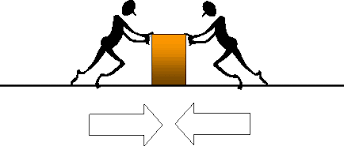
Net Force - total combined forces
Same direction - ADD
Opposite direction - SUBTRACT
36
Multiple Choice
Two forces act on an object to the right at the same time. What force is required to bring the object into equilibrium?
9 N to the right
9 N to the left
3 N to the left
18 N to the left
37
Multiple Choice
38
Multiple Choice
39
Multiple Choice
40
Multiple Choice
41
Multiple Choice
If the net force is equal to zero, the forces acting on the object are
balanced
unbalanced
42
Multiple Choice
43
Multiple Choice
44
Multiple Choice
45
Plate Boundary
Converge - COLLIDE
Diverge - DIVIDE
Transform - SLIDE
46
Multiple Choice
What type of boundary is this?
Divergent
Convergent
Transform
47
Multiple Choice
Which correctly identifies the geologic process that formed the Himalayan mountains (The World's Tallest Mountains, including Mt. Everest)?
Two continental plates converging
An earthquake in a subduction zone
A tectonic plate moving over a hot plate
Movement at a transform fault boundary
48
Multiple Choice
The Great Rift Valley in Africa and the Mid-Ocean Ridge were all created by this boundary
Divergent
Convergent
Reform
Transform
49
Multiple Choice
50
Phases of the Moon
29.5 day cycle
51
WAXING MOON - Increasing
Starts with New Moons
Ends with Full Moon
LIGHT ON THE RIGHT
52
WANING Moon - Decreasing
Full Moon back to New Moon
Light on the left.
53
Moon Phases
Each phases lasts about 3-5 days.
You can predict the phase of the moon.
54
Multiple Choice
55
Multiple Choice
56
Multiple Choice
57
Multiple Choice
58
Multiple Choice
59
Multiple Choice
60
Multiple Choice
61
Multiple Choice
62
Multiple Choice
63
Multiple Choice
64
Multiple Choice
65
Multiple Choice
Review and Moon
Show answer
Auto Play
Slide 1 / 65
SLIDE

Similar Resources on Wayground
58 questions
Ecology
Presentation
•
9th Grade
60 questions
Spheres, Layers, Rocks
Presentation
•
8th Grade
63 questions
Bridges
Presentation
•
8th Grade
61 questions
Formation and Shape of Galaxies
Presentation
•
8th Grade
61 questions
Formation and Motion of Galaxies
Presentation
•
8th Grade
61 questions
Galaxies
Presentation
•
8th Grade
59 questions
CA 1 Review
Presentation
•
7th Grade
63 questions
Air Temperature
Presentation
•
8th Grade
Popular Resources on Wayground
24 questions
PBIS-HGMS Day 10
Quiz
•
6th - 8th Grade
10 questions
HCS SCI 03 Summer School Review 3
Quiz
•
3rd Grade
11 questions
Home Scope
Quiz
•
7th - 8th Grade
15 questions
HCS SCI 05 Summer School Assessment 3 Review
Quiz
•
5th Grade
35 questions
Lufkin Road Middle School Student Handbook & Policies Assessment
Quiz
•
7th Grade
18 questions
Geo 11.3 Area of Circles and Sectors
Quiz
•
9th - 11th Grade