Adjectives - agreement and position
Presentation
•
World Languages
•
9th Grade
•
Practice Problem
•
Medium
Kaylene Zhang
Used 20+ times
FREE Resource
16 Slides • 11 Questions
1
Adjectives - agreement and position
2
Agreement
3
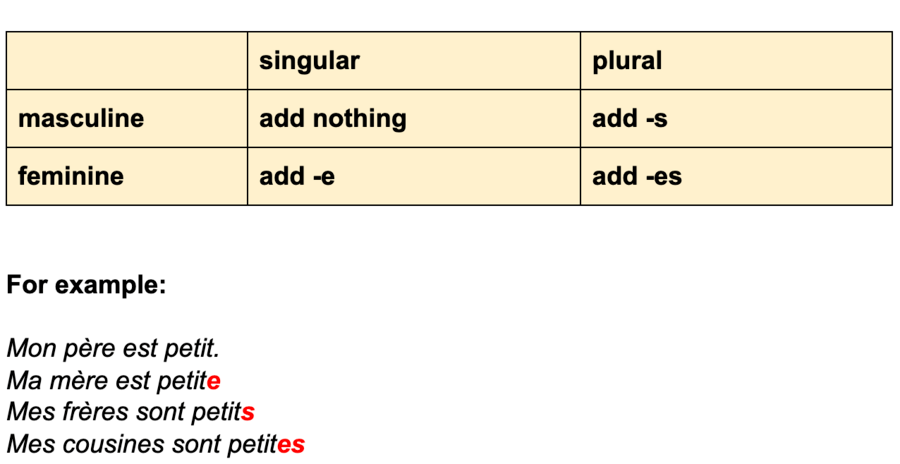
In French, adjectives need to agree/match with the nouns in NUMBER and GENDER.
4
Multiple Choice
Choose the correct form of the adjective.
Le chien est
intelligent
intelligente
5
Multiple Choice
Choose the correct form of the adjective.
Mes parents sont
marrant
marrants
marrantes
marrante
6
Multiple Choice
Choose the correct form of the adjective.
Juliette est
patient
patiente
patients
patientes
7
Multiple Choice
Choose the correct form of the adjective.
C'est une conversation
intéressant
intéressante
intéressants
intéressantes
8
Some Adjectives do not follow this regular pattern.
- Adjectives ending in -eur or -eux usually change to -euse in the feminine. e.g. Un frère travailleur → une sœur travailleuse
- Adjectives which already end in -e don’t add another -e in the feminine. e.g. Un frère calme → une sœur calme
- A few adjectives stay the same whether they are masculine or feminine, singular or plural: sympa, super, cool
9
See the doc "W4 L3" and booknotes for some other patterns.
10
Position
1. after the noun
11
In English, adjectives always come before the noun they describe:
A pleasant castle, a modern kitchen, nice friends
12
In French, adjectives usually come after the noun.
Un château agréable, une cuisine moderne, des amis sympa.
13
Fill in the Blanks
Type answer...
14
Fill in the Blanks
Type answer...
15
Position
2. Before the noun
16
Some adjectives break the rule and come before the noun.
Adjectives that refer to some specific qualities must precede the noun they describe instead of following it. The qualities they describe can be summarised by the acronym BAGS
17
B
B for beauty:
beau/belle/bel (before a masc. noun starting with a vowel) (beautiful, handsome)
joli/jolie(pretty)
18
A
A for age:
jeune (young)
vieux/vieille/vieil (before a masc. noun starting with a vowel) (old)
nouveau/nouvelle/nouvel (before a masc. noun starting with a vowel) (new)
19
G
G for goodness:
bon/bonne (good)
meilleur/meilleure (better)
mauvais/mauvaise (bad)
gentil/gentille (kind)
20
S
S for size:
petit/petite (small)
grand/grande (big)
haut/haute (high)
gros/grosse (fat)
21
Multiple Choice
Rewrite:
e.g. un chat/jeune = un jeune chat
un lit/grand
un lit grand
un grand lit
22
Multiple Choice
Rewrite:
une chaise/petit
une chaise petit
une chaise petite
une petite chaise
une petit chaise
23
Fill in the Blanks
Type answer...
24
Fill in the Blanks
Type answer...
25
Fill in the Blanks
Type answer...
26
Position
3. changed meaning depending on the position
27
Some French adjectives change their meaning depending on their position in the sentence.
La maison n’est pas propre. = The house is not clean.
C’est ma propre chambre. = This is my own room.
Adjectives - agreement and position

Show answer
Auto Play
Slide 1 / 27
SLIDE

Similar Resources on Wayground
20 questions
Introduction to Economics Review
Presentation
•
9th Grade
20 questions
Macromolecule review
Presentation
•
9th Grade
20 questions
Fragments
Presentation
•
9th Grade
22 questions
La fecha en español
Presentation
•
9th Grade
22 questions
El tiempo futuro (full lesson)
Presentation
•
9th - 10th Grade
18 questions
El Tiempo y Las Estaciones
Presentation
•
9th Grade
20 questions
ser vs estar
Presentation
•
8th Grade
22 questions
GoYo Verbs
Presentation
•
9th - 10th Grade
Popular Resources on Wayground
24 questions
PBIS-HGMS Day 10
Quiz
•
6th - 8th Grade
10 questions
HCS SCI 03 Summer School Review 3
Quiz
•
3rd Grade
11 questions
Home Scope
Quiz
•
7th - 8th Grade
15 questions
HCS SCI 05 Summer School Assessment 3 Review
Quiz
•
5th Grade
35 questions
Lufkin Road Middle School Student Handbook & Policies Assessment
Quiz
•
7th Grade
18 questions
Geo 11.3 Area of Circles and Sectors
Quiz
•
9th - 11th Grade