Endothermic vs exothermic
Presentation
•
Chemistry
•
10th - 11th Grade
•
Practice Problem
•
Easy
Standards-aligned
Kristen Vanderveen
Used 33+ times
FREE Resource
10 Slides • 9 Questions
1
Review: Endothermic vs Exothermic Processes
Bromfield Honors Chemistry
2
Multiple Choice
Energy that transfers from one substance to another until the temperatures are equal is called...
free energy
temperature
entropy
heat
3
Multiple Choice
Which of the following describes the heat transfer when you hold an ice cube in your hand?
from the cold ice cube to your warm hand
the cold ice cube makes your hand cold
from your warm hand to the cold ice cube
no heat transfer occurs
4
5
6
Multiple Choice
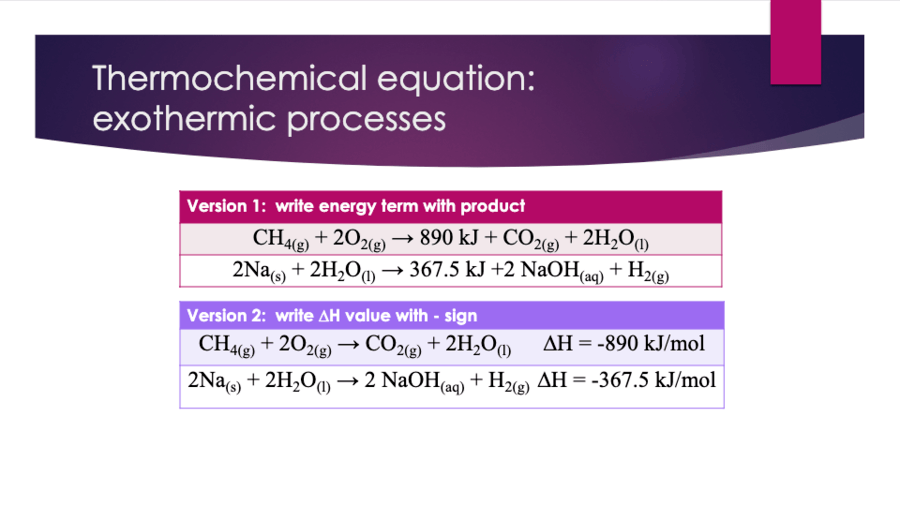
A(n) _____ is a balanced chemical equation that includes the physical states of all reactants and products and the energy change that accompanies the reaction
thermochemical equation
enthalpy of combustion
formation reaction
molar enthalpy of vaporization
7
8
9
10
11
12
Multiple Choice
A hot marble is dropped into a container of cool water. Which of the following statements most accurately describes the molecular motion of molecules?
Both the marble molecules and the water molecules will slow down until they eventually come to rest.
The marble molecules will slow down while the water molecules speed up until they reach reach the same average kinetic energy.
The marble molecules will speed up while the water molecules will slow down until they reach nearly identical speeds.
Both the marble molecules and the water molecules will speed up until they reach nearly identical speeds.
13
14
Multiple Choice
If the enthalpy (ΔH) is negative the reaction is ____.
endothermic
exothermic
15
Multiple Choice
If ΔH is positive, heat would be shown on the _____ side of the thermochemical equation.
reactant
product
16
Multiple Choice
A positive ΔH means that:
In order for the reaction to happen, heat must be added to the system.
The process is exothermic
In order for the reaction to happen, heat must be added to the system.
The process is endothermic.
When the reaction happens, heat is released to the surroundings. The process is exothermic
When the reaction happens, heat is released to the surroundings. The process is endothermic
17
Multiple Choice
A negative ΔH means the reaction is:
complete
at equilibrium
exothermic
endothermic
18
If we "flip" a thermochemical equation (ie., write it backwards), the sign of ΔH changes
ex.
+ΔH: A + B + heat ⟶ C
-ΔH: C ⟶ A + B + heat
19
Multiple Choice
Is the following process exothermic or endothermic?
2 Al + 3CuCl2 ⟶ 2AlCl3 + 3 Cu + heat
endothermic
exothermic
Review: Endothermic vs Exothermic Processes
Bromfield Honors Chemistry
Show answer
Auto Play
Slide 1 / 19
SLIDE

Similar Resources on Wayground
15 questions
Composition of Functions
Presentation
•
10th - 11th Grade
13 questions
Getting around
Presentation
•
10th - 11th Grade
14 questions
Electron Math
Presentation
•
9th - 12th Grade
14 questions
L1 Types of Matter
Presentation
•
10th - 12th Grade
14 questions
Balancing Chemical Equations
Presentation
•
10th Grade
16 questions
Scientific Method
Presentation
•
9th - 11th Grade
13 questions
Acids/Bases
Presentation
•
9th - 10th Grade
13 questions
Chapter 6 Section 5 Part 1: Molecular Geometry VSEPR
Presentation
•
10th - 12th Grade
Popular Resources on Wayground
24 questions
PBIS-HGMS Day 10
Quiz
•
6th - 8th Grade
10 questions
HCS SCI 03 Summer School Review 3
Quiz
•
3rd Grade
11 questions
Home Scope
Quiz
•
7th - 8th Grade
15 questions
HCS SCI 05 Summer School Assessment 3 Review
Quiz
•
5th Grade
35 questions
Lufkin Road Middle School Student Handbook & Policies Assessment
Quiz
•
7th Grade
18 questions
Geo 11.3 Area of Circles and Sectors
Quiz
•
9th - 11th Grade