Topic 1.1 Water and Hydrogen Bonding
Presentation
•
Biology
•
11th - 12th Grade
•
Medium
+6
Standards-aligned
Erica Putnam
Used 7+ times
FREE Resource
16 Slides • 24 Questions
1
Topic 1.1 Water and Hydrogen Bonding
2
3
4
Multiple Choice
The Hydrogen atoms in the molecule shown have this charge:
Positive
Partial Positive
Negative
Partial Negative
5
Multiple Choice
The Oxygen atoms in the molecule shown have this charge:
Positive
Partial Positive
Negative
Partial Negative
6
Multiple Choice
7
8
Multiple Choice
9
Multiple Choice
Why is it important that ice is less dense than liquid water?
It lowers the pH of lakes and ponds
It disrupts hydrogen bonds.
It allows nonpolar substances to dissolve in water.
It creates an ice layer on the surface of lakes and ponds, and prevents them from completely freezing.
10
11
Hydrogen Bonds Cause:
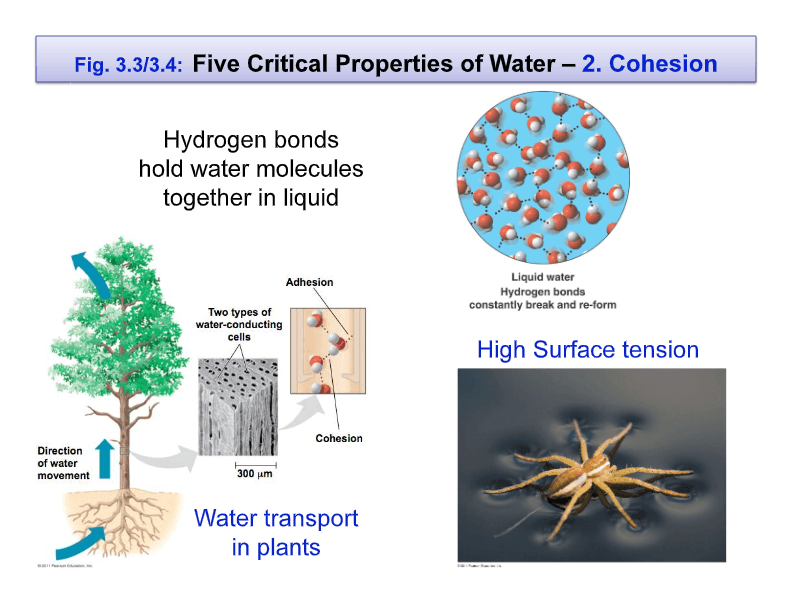
Cohesion - water sticks to water
Adhesion - water sticks to other molecules
12
13
14
Multiple Choice
15
Multiple Choice
When we added red food coloring to the water, what did that prove?
That the celery leaves caught the evaporating red water.
That the celery was absorbing all the red water.
That the water was passing through the celery all the way up to the leaves.
16
Multiple Choice
17
Multiple Choice
Small insects can walk across the surface of calm water. Their feet push the surface of the water down slightly, somewhat like a person walking across a trampoline, but they do not break the surface. What is the best explanation for why this happens?
The insects are light enough so that they do not break the hydrogen bonds holding the water molecules together
The insects actually use their wings to hover slightly above the water's surface and they only skim it with their feet
The insects' feet are non-polar, so they are repelled by the polar water molecules and are pushed away from the water's surface
The insects are small enough to see the individual water molecules, so they are able to step carefully from one molecule to the next
18
Multiple Choice
19
Multiple Choice
capillary action
atoms
20
21
Multiple Choice
22
Multiple Choice
Water has an unusually high boiling point for a molecular compound because it has
hydrogen bonding
ion-ion attractions
a high density
a large gram formula mass
23
24
25
26
Multiple Choice
27
Multiple Choice
What kind of molecule is water?
Ionic
Polar Covalent
Nonpolar Covalent
Metallic
28
Multiple Choice
29
30
pH and [H+] Concentration
pH = - log [H+]
Inverse relationship between pH and [H+]
Low pH has a higher concentration of [H+] ions.
Changes by a factor of 10 as you move down the scale
31
32
Buffers & Homeostasis
Buffers are a weak conjugate acid-base pair.
They resist changes in pH by adding or removing H+ ions from solution.
Buffers in the body maintain physiological pH (6.5-8.0)
33
Multiple Choice
What does pH measure?
the amount of hydrogen (H+) ions
the amount of hydroxide (OH-) ions
amount of water
all of the above
34
Multiple Choice
Which of the following pH measurements has the highest [H+] concentration?
1
4
8
14
35
Multiple Choice
36
Multiple Choice
37
Multiple Choice
38
Multiple Choice
39
Multiple Choice
What is a mixture of chemicals that react with a base/acid to keep pH in a particular range?
catalyst
enzyme
water
buffer
40
Multiple Choice
Water has a neutral pH because
it has more H+ ions than OH-
it has more OH- ions than H+
it does not produce any ions
it has an equal amount of H+ and OH- in solution
Topic 1.1 Water and Hydrogen Bonding
Show answer
Auto Play
Slide 1 / 40
SLIDE

Similar Resources on Wayground
32 questions
APB - Unit 4 - Cell Communication & Cell Cycle 3 #GoBioRams
Presentation
•
11th - 12th Grade
32 questions
Reproduction of Representative Animals
Presentation
•
11th - 12th Grade
35 questions
Hydroponics
Presentation
•
11th - 12th Grade
34 questions
6.6A - Hormones
Presentation
•
11th - 12th Grade
33 questions
When Wilma met Fred
Presentation
•
11th - 12th Grade
35 questions
Lesson: Electron Configuration
Presentation
•
11th Grade
34 questions
Stoichiometry Review
Presentation
•
10th - 12th Grade
Popular Resources on Wayground
24 questions
PBIS-HGMS Day 10
Quiz
•
6th - 8th Grade
10 questions
HCS SCI 03 Summer School Review 3
Quiz
•
3rd Grade
11 questions
Home Scope
Quiz
•
7th - 8th Grade
15 questions
HCS SCI 05 Summer School Assessment 3 Review
Quiz
•
5th Grade
35 questions
Lufkin Road Middle School Student Handbook & Policies Assessment
Quiz
•
7th Grade
18 questions
Geo 11.3 Area of Circles and Sectors
Quiz
•
9th - 11th Grade