


Waves ~ Properties
Presentation
•
Science
•
8th Grade
•
Practice Problem
•
Hard
Marissa Kitchen
Used 100+ times
FREE Resource
10 Slides • 0 Questions
1
Waves ~ Properties
2
Transfer of Energy
Just like wave particles, dominoes transfer energy from one to the next, without any one domino having to move the whole distance across the table.
Motion of waves moves energy from one place to another.
Waves are distinct from other energy transport systems because they can transport energy without the need to transport matter.
3
Mechanical Waves vs Electromagnetic Waves
electromagnetic waves or light waves transfer energy, they travel through space and do not need a medium.
Mechanical waves transfer energy through a medium.
4
transverse and longitudinal waves
transverse~ Seismic S Waves. Rope waves
longitudinal waves~ Sounds Waves, spring waves
5
Characteristics of a Wave
The highest point a wave reaches above equilibrium (midline) is its crest and the lowest point a wave reaches below equilibrium is its trough.
Waves are measured by their amplitude, wavelength, and frequency.
amplitude equals half the vertical distance from crest to trough.
6
Sound Waves
In sound waves, amplitude corresponds to loudness; as the wave amplitude increases, so does the loudness of the sound and the energy.
The waves with the most amplitude are the loudest and have the most energy.
7
Wavelength
Wavelength determines which waves we can sense.
Humans can hear sound waves with wavelengths between about 0.02 m (high pitches) and 20 m (low pitches).
8
Frequency
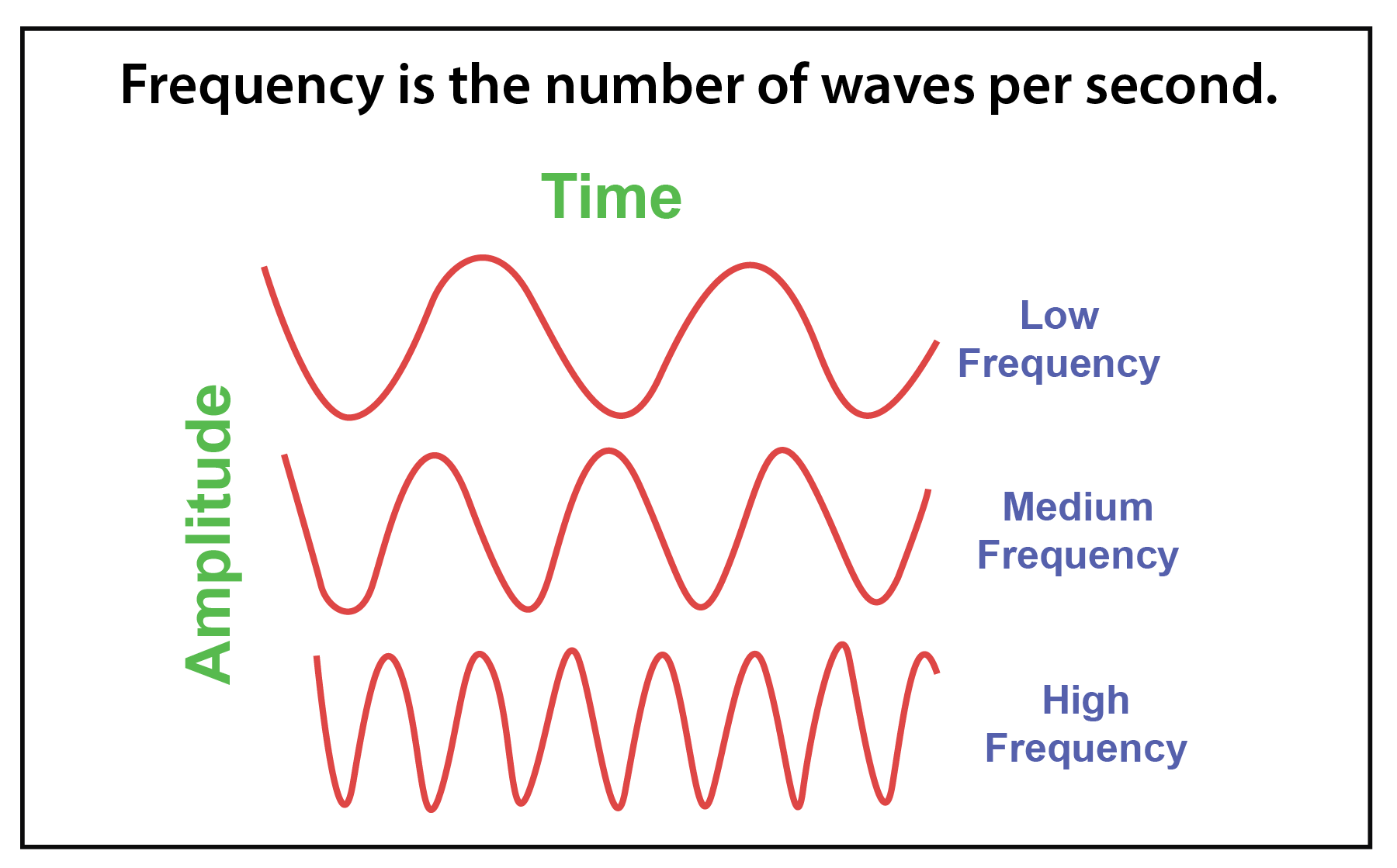
Frequency is a measure of the number of times a wave cycles per unit of time (typically 1 second).
Frequency is also defined as the number of waves that pass a certain point in 1 second. Waves with higher frequencies have more energy.
9
Relationship
The amount of energy transferred by waves in a given time is proportional to its frequency. This simply means that if a wave’s frequency doubles, the amount of energy being transferred by the wave doubles.
10
To summarize:
The amount of energy transferred by waves in a given time is proportional to the frequency.
the energy of a wave is proportional to the square of the amplitude.
in a sound wave, frequency determines pitch.
in a sound wave, amplitude determines volume.
Waves ~ Properties

Show answer
Auto Play
Slide 1 / 10
SLIDE

Similar Resources on Wayground
8 questions
Gas pressure
Presentation
•
8th Grade
7 questions
Velocity
Presentation
•
8th Grade
9 questions
soil
Presentation
•
7th Grade
8 questions
Fraction to Decimal
Presentation
•
8th Grade
8 questions
Investigations
Presentation
•
8th Grade
8 questions
Dissection Safety
Presentation
•
8th Grade
9 questions
How Light Behaves
Presentation
•
8th Grade
7 questions
Plate tectonics
Presentation
•
8th Grade
Popular Resources on Wayground
10 questions
Safety Day 2026 – Student Review
Quiz
•
9th Grade
21 questions
Continents and Oceans
Quiz
•
6th Grade
20 questions
Parts of Speech
Quiz
•
5th Grade
16 questions
Subject & Predicate
Quiz
•
5th Grade
25 questions
Multiplication Facts
Quiz
•
5th Grade
12 questions
Map Skills
Quiz
•
3rd Grade
22 questions
Continents and Oceans
Quiz
•
5th Grade
15 questions
Rounding Decimals
Quiz
•
5th Grade
Discover more resources for Science
20 questions
Newton's Laws of Motion
Quiz
•
8th Grade
15 questions
potential and kinetic energy
Quiz
•
8th Grade
21 questions
Newton's Laws of Motion
Quiz
•
8th Grade
20 questions
Elements, Compounds and Mixtures
Quiz
•
8th Grade
10 questions
Exploring Chemical and Physical Changes
Interactive video
•
6th - 10th Grade
20 questions
Physical vs Chemical Changes
Quiz
•
8th Grade
20 questions
Conduction, convection, and Radiation Practice
Quiz
•
8th Grade
21 questions
Waves and Wave Properties
Quiz
•
6th - 8th Grade