
The Atom Review
Presentation
•
Chemistry
•
9th - 12th Grade
•
Hard
Standards-aligned
Lauren Wells
Used 8+ times
FREE Resource
11 Slides • 18 Questions
1
The Atom
Review
2
Battle of the Greeks
Aristotle: Continuous Theory
-Matter can be divided infinitely
Democritus & Leucippus: Discontinuous Theory
- There is a tiny indivisible particle called an atom
3
Dalton's Atomic Theory
1. Elements are made of atoms
2. Atoms of an element are the same.
3. Compounds are formed from combinations of atoms
4
JJ Thomson: Plum Pudding Model
Discovered the electrons while performing experiments with cathode rays
5
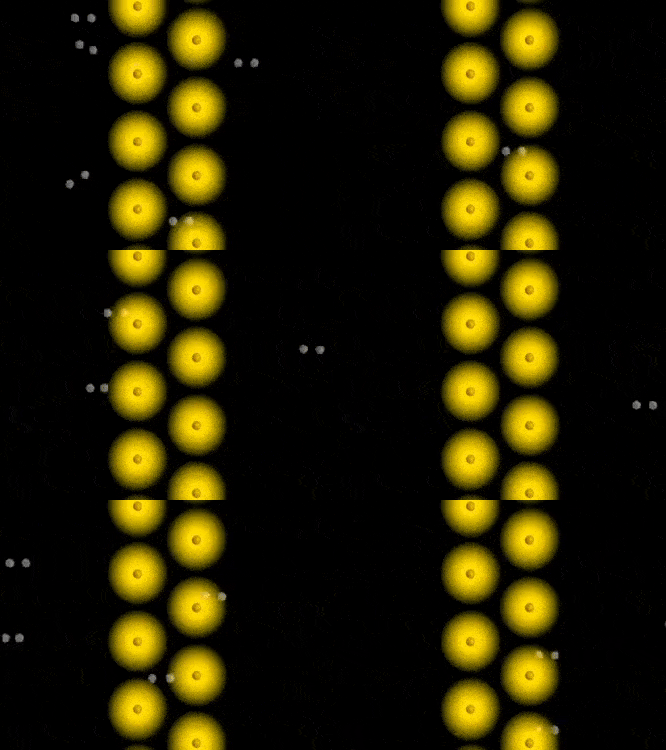
Ernest Rutherford: Nuclear Model
Performed Gold Foil Experiment
- Proved the atom was mostly empty space
- Discovered the dense, tiny, positive nucleus
6
Niel's Bohr: Planetary Model
Proposed e- traveled in fixed paths around the nucleus.
Each level can hold a maximum # of e-
Energy Level = Shell
7
Modern Atomic Model
AKA Wave-Mechanical or Electron Cloud
e- behave like waves and particles
Orbitals = most probable location of an e-
Electrons don't orbit the nucleus
8
Multiple Choice
What happened to the cathode ray during Thomson’s experiment?
It was repelled by a positive charge
It bounced back to the cathode
It was stopped by a magnet
It was deflected away from a negative charge
9
Multiple Choice
Which of the following was a result of the gold foil experiment?
Most alpha particles bounced back.
All alpha particles went straight through.
Some alpha particles bounced back.
None of the above
10
Multiple Choice
Number 1 is _ while number 2 is _.
(+), (-)
(-), (+)
neutral , (+)
neutral, (-)
11
Multiple Choice
What conclusion did Rutherford come to after the gold foil experiment?
Most of the atom is empty space.
A dense region of (+) charge existed in the atom.
Thomson’s model was incorrect.
All of the above
12
Excited vs Ground State
Electrons jump to higher energy level when energy is absorbed
Electrons return to original ground state energy level when energy is released as light
Emission spectra used to identify elements (fingerprint)
Number of electrons doesn't change
13
Multiple Choice
Which of the following shows an excited state electron configuration?
2-7-1
2-4
2-8-4
2-8-1
14
Multiple Choice
Which is a possible excited state electron configuration for Si?
2-8-4
1-9-4
2-8-8
2-8-3-1
15
Multiple Choice
16
Multiple Choice
What happens to energy as an atom goes from ground state to excited state?
It increases
It decreases
It remains the same
17
Using the Periodic Table
# p+ = 8
# e- = 8
# n0 = 16 - 8 = 8
18
Multiple Choice
The nucleus of most atoms are made of:
protons and electrons
neutrons and electrons
electrons and protons
protons and neutrons
19
Multiple Select
The letter “X” in the diagram marks the:
select all that apply
Location of the neutrons
Electron cloud
Nucleus
Region of greatest density
Location of the electrons
20
Multiple Select
Which of the following descriptions apply to the nucleus?
(select all that apply)
positively charged
mostly empty space
small
dense
21
Multiple Choice
The _ constitute most of the volume of an atom
nucleus
protons
electrons
neutrons
22
Isotopes
Same number of protons & electrons (atomic #)
Different number of neutrons (mass number)
23
Multiple Choice
If we assume pink represents protons and green represents neutrons, the nucleus depicted here is:
boron-5
boron-6
boron-11
carbon 11
24
Multiple Select
What is special about the atomic number?
Equals the number of protons in an atom
Identifies an element
Equals the number of electrons in an atom
Equals the number of neutrons in an atom
25
Multiple Choice
26
Multiple Choice
27
Weighted Atomic Mass
Atomic mass = average of naturally occurring isotopes
Atomic mass will be closer to the most abundant isotope
28
Multiple Choice
A new element, Tyserium (Ty), has recently been discovered and consists of two isotopes. One isotope has a mass of 331 amu and is 35.0 % abundant. The other isotope is 337 amu and is 65.0 % abundant. What is the mass of Ty as it appears on the periodic table?
335 amu
334 amu
333 amu
332 amu
29
Fill in the Blanks
Type answer...
The Atom
Review
Show answer
Auto Play
Slide 1 / 29
SLIDE

Similar Resources on Wayground
21 questions
Density (PS)
Presentation
•
8th - 11th Grade
22 questions
Accuracy v. Precision, Sig Figs, and Scientific Notation
Presentation
•
9th - 12th Grade
20 questions
Types of Reactions
Presentation
•
9th - 12th Grade
25 questions
Electron Configuration, Orbital Notation, & Dot diagrams
Presentation
•
9th - 12th Grade
20 questions
Periodic Trends
Presentation
•
10th - 12th Grade
26 questions
Stoichiometry Lesson
Presentation
•
9th - 12th Grade
22 questions
How big is a mole?
Presentation
•
9th - 12th Grade
21 questions
Chemistry Unit 9: Lesson 1 Solutions and Molarity
Presentation
•
10th - 12th Grade
Popular Resources on Wayground
24 questions
PBIS-HGMS Day 10
Quiz
•
6th - 8th Grade
10 questions
HCS SCI 03 Summer School Review 3
Quiz
•
3rd Grade
11 questions
Home Scope
Quiz
•
7th - 8th Grade
15 questions
HCS SCI 05 Summer School Assessment 3 Review
Quiz
•
5th Grade
35 questions
Lufkin Road Middle School Student Handbook & Policies Assessment
Quiz
•
7th Grade
18 questions
Geo 11.3 Area of Circles and Sectors
Quiz
•
9th - 11th Grade