Y10T2W7L2 Revision Separating Techniques
Presentation
•
Chemistry
•
10th Grade
•
Medium

Christina Celine Sutherland
Used 7+ times
FREE Resource
22 Slides • 25 Questions
1
2
3
Open Ended
4
5
6
7
8
9
10
11
12
13
14
15
Open Ended
16
17
18
19
20
21
22
Open Ended
23
24
25
26
Multiple Choice
Ethanol has a higher boiling point than water.
Ethanol has a lower melting point than water.
Ethanol has a higher melting point than water.
Ethanol has a lower boiling point than water.
27
Multiple Choice
This makes it impossible to calculate Rf values.
This makes it impossible to use a locating agent.
This results in a safety hazard caused by solvent fumes.
This causes the spot nearest the bottom of the paper to catch up with the spot above it.
28
Multiple Choice
29
Multiple Choice
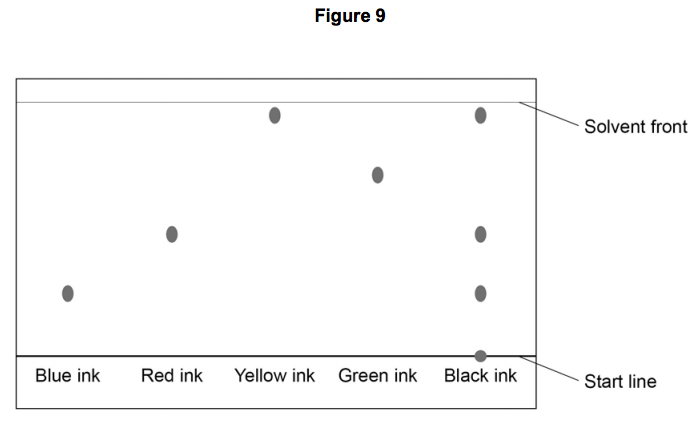
Which ink is most soluble?
Blue
Red
Yellow
Green
30
Multiple Choice
A
B
C
D
31
Multiple Choice
Select the correct equation to calculate Rf values.
(Distance travelled by solvent) ÷ (Distance travelled by sample)
(Distance travelled by sample) ÷ (Distance travelled by solvent)
32
Multiple Choice
Label number 1 in the above experiment.
Solvent front
Solvent
Baseline
33
Multiple Select
Rf values can be obtained with the following information.
Distance moved by the solvent.
Width of the baseline.
Length of the chromatography paper.
Distance that the substance has moved.
34
Multiple Choice
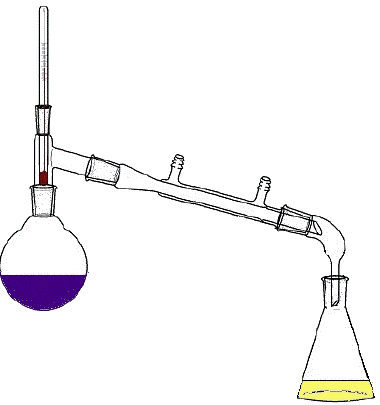
What is the method suitable to obtain pure water from seawater.
Simple distillation
Fractional distillation
Filtration
Evaporation to dryness
35
Multiple Choice
A
B
C
D
36
Multiple Choice
What method is used to obtain copper(II) sulfate crystals from its solution?
Crystallisation
Evaporation to dryness
Paper chromatography
Fractional distillation
37
Multiple Choice
A mixture contains two substances. What property must be the two substances have for them to be separated by paper chromatography?
Both substances must be soluble in the chromatography solvent,
Both substances must have low boiling point.
Both substances must be coloured.
Both substances must be solid at room condition.
38
Multiple Choice
39
Multiple Choice
Which property indicates that a solid is pure?
It burns completely in oxygen, leaving no residue.
It has a fixed melting point.
It has a fixed volume.
It is soluble in water.
40
Multiple Choice
41
Multiple Choice
42
Multiple Choice
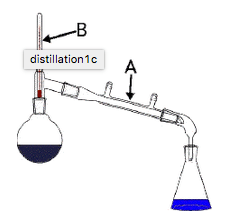
Distillation is used to separate ______.
an insoluble solid from its solution.
a soluble solid from its solution.
43
Multiple Choice
A pure substance shows -------spot(s) on chromatogram
0
1
2
3
44
Multiple Choice
45
Multiple Choice
46
Multiple Choice
Distillation is made up of ___
boiling, evaporation and then condensation
condensation, boiling and evaporation
47
Multiple Choice
A leibeg condenser is used in...
Filtration
Chromatography
Evaporation
Distillation
Show answer
Auto Play
Slide 1 / 47
SLIDE

Similar Resources on Wayground
44 questions
Water Resources
Presentation
•
11th Grade
44 questions
Chemical Reactions.2
Presentation
•
10th Grade
45 questions
Unit 2 English 10 Global Success
Presentation
•
10th Grade
41 questions
The blood and blood vessels
Presentation
•
9th - 10th Grade
44 questions
Cell membrane Lesson
Presentation
•
10th Grade
40 questions
Chemistry Unit 3 Lesson 4: Basics of Calorimetry
Presentation
•
11th Grade
40 questions
Balancing and 5 Types of Chemical Reactions
Presentation
•
9th - 12th Grade
43 questions
Chemistry Unit 8 Lesson 1: The Mole and Intro to Stoich
Presentation
•
10th - 12th Grade
Popular Resources on Wayground
10 questions
Safety Day 2026 – Student Review
Quiz
•
9th Grade
21 questions
Continents and Oceans
Quiz
•
6th Grade
20 questions
Parts of Speech
Quiz
•
5th Grade
16 questions
Subject & Predicate
Quiz
•
5th Grade
25 questions
Multiplication Facts
Quiz
•
5th Grade
12 questions
Map Skills
Quiz
•
3rd Grade
22 questions
Continents and Oceans
Quiz
•
5th Grade
15 questions
Rounding Decimals
Quiz
•
5th Grade
Discover more resources for Chemistry
20 questions
electron configurations and orbital notation
Quiz
•
9th - 12th Grade
25 questions
Writing and Naming Binary Ionic compounds
Quiz
•
10th Grade
20 questions
COUNTING ATOMS
Quiz
•
10th Grade
20 questions
Physical or Chemical Change/Phases
Quiz
•
8th Grade - University
15 questions
Periodicity Module Exam Practice Quiz
Quiz
•
9th - 12th Grade
20 questions
Naming Ionic Compounds
Quiz
•
10th Grade
45 questions
Chem Unit 3 Review
Quiz
•
10th Grade
16 questions
History of the Atomic Theory
Quiz
•
10th Grade