


Unit 1 Review
Presentation
•
Science
•
6th - 8th Grade
•
Medium
Standards-aligned
Charla Southers
Used 5+ times
FREE Resource
20 Slides • 10 Questions
1
Unit 1 Review
2
Earthquakes
Sudden release of energy from inside Earth, which can result in significant shaking of Earth's surface.
Energy is released when movement occurs along large cracks called faults in Earth's outer layer.
3
Tectonic Plates
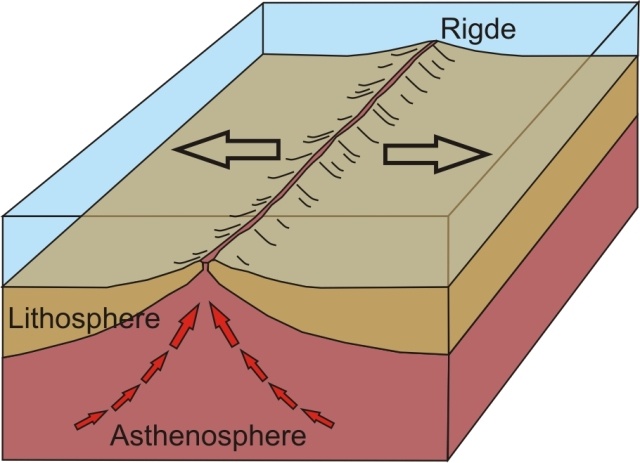
Earth's crust is split into tectonic plates that move slowly over time causing earthquakes along boundaries.
lithosphere - location of the tectonic plates
asthenosphere - layer of the mantle directly below the lithosphere
4
Earthquakes can be described in 2 ways
Magnitude is the number that describes the total amount of energy released at the source of an earthquake.
Intensity describes the kind of damage caused by an earthquake.
Magnitude affects intensity because an earthquake of a higher magnitude releases more energy than an earthquake of a lower magnitude.
5
Measuring Earthquakes
Richter scale - measures magnitude
Modified Mercalli Scale - measures intensity
6
Seismometers
Instrument used to measure the strength of an earthquake. Measure the waves traveling across the ground and the time that they arrived.
7
Seismogram
P wave - Primary wave (arrive first)
S wave - Secondary wave (arrive second)
Surface Waves arrive last
8
Earthquake Epicenter
focus -Location beneath earth's surface where the energy of an earthquake is located.
epicenter - location directly above the focus.
9
Types of Boundaries
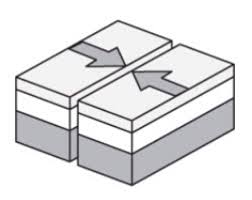
Divergent - plates move away from each other
Convergent - plates move toward each other
Transform - plates slide past each other
10
Types of Faults
Normal Fault
Reverse Fault
Strike-Slip Faults
11
Latitude and Longitude
latitude - distance north or south of the equator
longitude - distance east or west of the prime meridian
12
Ring of Fire
Area around the pacific plate where lots of earthquakes and volcanoes are located due to the constant shifting of the plate.
13
Rock Cycle
3 types of Rocks:
Igneous
Sedimentary
Metamorphic
14
3 types of rocks
Igneous rock - formed from cooled magma
Metamorphic rock - formed by heat and pressure
Sedimentary rock - formed from sediments after they are compacted and cemented together.
15
16
17
18
Volcanoes
3 types
Shield
Composite/Stratovolcano
Cinder Cone Volcano
19
3 types of volcanoes
Shield volcanoes are wide, with a broad slope. They form over hot spots and divergent boundaries. They produce runny lava.
Composite Volcanoes are tall and pointed. They form from alternating eruptions of lava and ash. The lava is sticky and does not flow. Form at convergent boundaries.
Cinder cone volcanoes are smaller cone shaped volcanoes. The eruptions contain thick magma. The lava may harden in the air and fall as fragments (cinders)
20
21
Multiple Choice
Any rock that forms from another rock as a result of changes in heat or pressure (or both) is a:
chemical rock
igneous rock
sedimentary rock
metamorphic rock
22
Multiple Choice
23
Multiple Choice
24
Multiple Choice
25
Multiple Choice
26
Multiple Choice
27
Multiple Choice
What is the minimum number of seismograph stations needed to locate an earthquake epicenter?
1
2
3
5
28
Multiple Choice
What type of fault is this?
Normal
Reverse
Strike-slip
29
Multiple Choice
What scale determines the amount of damage an earthquake causes?
Richter scale
Mercalli scale
Moment magnitude scale
seismographic scale
30
Multiple Choice
The place where an earthquake originates inside the Earth's surface is called...
Epicenter
Focus
Underground
Crust
Unit 1 Review

Show answer
Auto Play
Slide 1 / 30
SLIDE

Similar Resources on Wayground
21 questions
Engineering Design Process Vocabulary
Presentation
•
6th - 8th Grade
23 questions
Cell Division and cell cycle
Presentation
•
5th - 8th Grade
24 questions
Properties of Matter
Presentation
•
6th - 9th Grade
20 questions
Relative Dating
Presentation
•
6th - 8th Grade
25 questions
Genetics Introduction
Presentation
•
6th - 7th Grade
23 questions
The Rock Cycle Review
Presentation
•
7th - 8th Grade
24 questions
Mean, Median, Mode, Range
Presentation
•
6th - 8th Grade
24 questions
Energy Transformation
Presentation
•
6th - 8th Grade
Popular Resources on Wayground
10 questions
Safety Day 2026 – Student Review
Quiz
•
9th Grade
21 questions
Continents and Oceans
Quiz
•
6th Grade
20 questions
Parts of Speech
Quiz
•
5th Grade
16 questions
Subject & Predicate
Quiz
•
5th Grade
25 questions
Multiplication Facts
Quiz
•
5th Grade
12 questions
Map Skills
Quiz
•
3rd Grade
22 questions
Continents and Oceans
Quiz
•
5th Grade
15 questions
Rounding Decimals
Quiz
•
5th Grade
Discover more resources for Science
20 questions
Newton's Laws of Motion
Quiz
•
8th Grade
20 questions
Elements, compounds, and mixtures
Quiz
•
6th Grade
10 questions
6.6D - Relative Density Review
Quiz
•
6th Grade
15 questions
potential and kinetic energy
Quiz
•
8th Grade
21 questions
Newton's Laws of Motion
Quiz
•
8th Grade
20 questions
Elements, Compounds and Mixtures
Quiz
•
8th Grade
10 questions
Exploring Chemical and Physical Changes
Interactive video
•
6th - 10th Grade
20 questions
CONDUCTION,CONVECTION AND RADIATION
Quiz
•
6th Grade