

Grade IX Geography : All About Glaciers

Presentation
•
Geography
•
9th - 10th Grade
•
Practice Problem
•
Medium

Jamshid Minwalla
Used 17+ times
FREE Resource
25 Slides • 6 Questions
1
Grade IX Geography : All About Glaciers
This lesson will cover all aspects about glaciers.

2
What is a glacier?
A glacier is a huge mass of ice that moves slowly over land. The term “glacier” comes from the French word glace (glah-SAY), which means ice. Glaciers are often called “rivers of ice.” Glaciers fall into two groups: alpine glaciers and ice sheets. The image here is an alpine glacier.

3
What is an alpine glacier?
Alpine glaciers form on mountainsides and move downward through valleys.
Sometimes, alpine glaciers create or deepen valleys by pushing dirt, soil, and other materials out of their way.
Alpine glaciers are also called valley glaciers or mountain glaciers.

4
What is continental glacier?
Continental glaciers are continuous masses of ice that are much larger than alpine glaciers.
Small continental glaciers are called ice fields.
Big continental glaciers are called ice sheets. Greenland and Antarctica are almost entirely covered with ice sheets that are up to 3500 m (11 500 ft) thick.

5
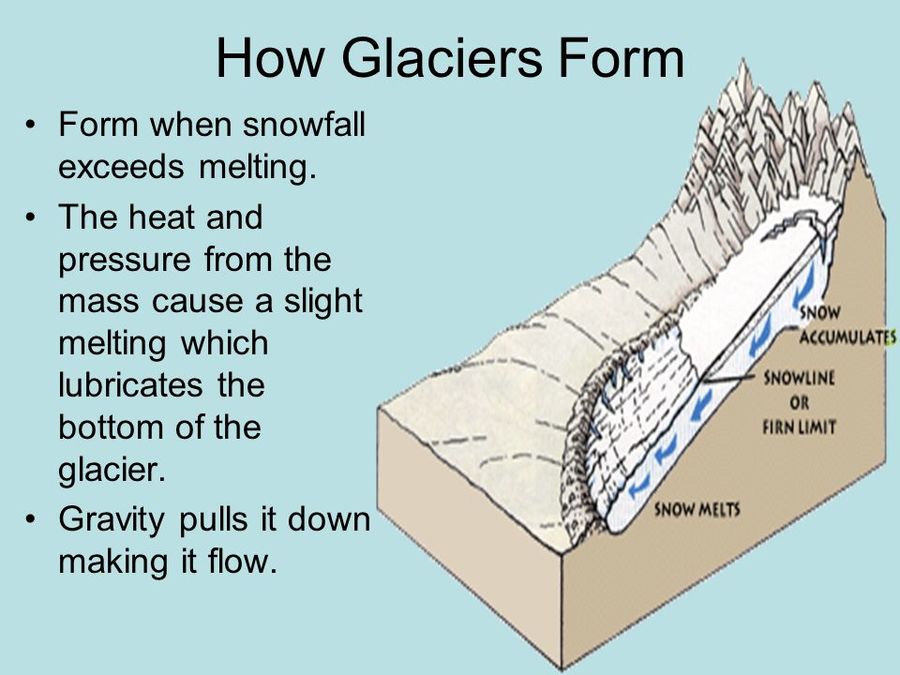
How do glaciers form?
Snowfall exceeds melting
Heat and pressure from the mass cause a slight melting which lubricates the botom of the glacier.
Gravity pulls it down making it flow
6
Multiple Choice

What type of glacier forms in a mountainous area?
7
Multiple Choice
Glaciers form when _____.
8
Multiple Choice

Glaciers move because of ______________
9
Glacial Terminology
Inputs: Snow and rain
Processes: Accumulation, Transportation, Plucking, Abrasion, Ablation
Outputs: Meltwater, Morraine

10
What is plucking?
In glacial erosion, in addition to abrasion (q.v.) which leaves striations, gouge marks, etc., a peculiar pulling away process is called glacial plucking or quarrying, because it involves the dislodging and removal of large fragments and boulders.

11
What is abrasion?
Abrasion occurs when rocks and stones become embedded in the base and sides of the glacier. These are then rubbed against the bedrock (at the bottom of the glacier) and rock faces (at the sides of the glacier) as the glacier moves. This causes the wearing away of the landscape as the glacier behaves like sandpaper.
12
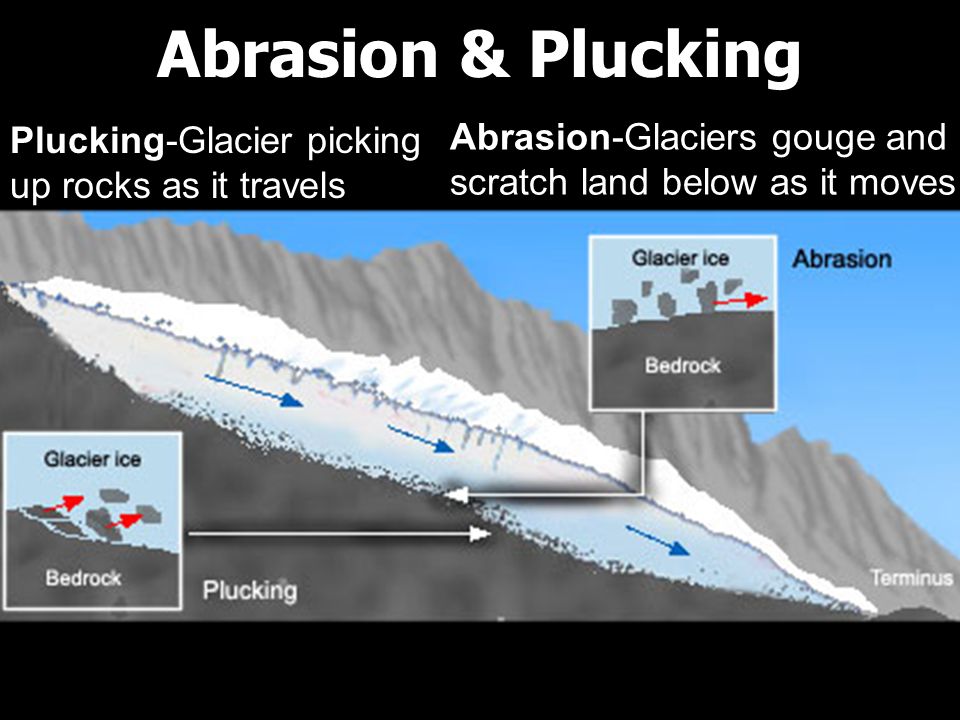
Plucking occurs when rocks and stones become frozen to the base or sides of the glacier and are plucked from the ground or rock face as the glacier moves. ... Abrasion occurs when rocks and stones become embedded in the base and sides of the glacier.
13

Abrasion or Plucking?
14

Abrasion or Plucking?
15
What is ablation?
As ice flows downhill, it either reaches warmer climates, or it reaches the ocean. This causes various processes of melt, or ablation, to occur.

16
What is a moraine?
A moraine is material left behind by a moving glacier. This material is usually soil and rock. Just as rivers carry along all sorts of debris and silt that eventually builds up to form deltas, glaciers transport all sorts of dirt and boulders that build up to form moraines

17

Types of moraines
18
Multiple Select
19
Multiple Choice
20
What is meltwater?
Meltwater is water released by the melting of snow or ice, including glacial ice, tabular icebergs and ice shelves over oceans.

21
What is calving?
Ice calving, also known as glacier calving or iceberg calving, is the breaking of ice chunks from the edge of a glacier. It is a form of ice ablation or ice disruption. It is the sudden release and breaking away of a mass of ice from a glacier, iceberg, ice front, ice shelf, or crevasse.

22
What are some of the landforms formed by glaciers?
Glaciers cause erosion by plucking and abrasion. Valley glaciers form several unique features through erosion, including cirques, arêtes, and horns. Glaciers deposit their sediment when they melt. Landforms deposited by glaciers include drumlins, kettle lakes, and eskers.

23
Glacier Deposit Landforms: What is a drumlin?
A drumlin, is an elongated hill in the shape of an inverted spoon or half-buried egg formed by glacial ice acting on underlying unconsolidated till or ground moraine.

24
Glacier Deposit Landforms: What is a kettle lake?
Kettles are depressions left behind after partially-buried ice blocks melt. Many are filled with water, and are then called "kettle lakes".

25
Glacier Deposit Landforms: What is an esker?
Eskers are formed within ice-walled tunnels by streams that flowed within and under glaciers. They tended to form around the time of the glacial maximum, when the glacier was slow and sluggish. After the retaining ice walls melted away, stream deposits remained as long winding ridges.

26

What glacial erosion landform is this?
27

What glacial erosion landform is this?
28

What glacial erosion landform is this?
29

What glacial erosion landform is this?
30

What glacial erosion landform is this?
31
Open Ended

HW: Take a look at the image and provide a detailed explanation of how glaciers are formed, how they move, and how they shape glacial landforms.
Grade IX Geography : All About Glaciers
This lesson will cover all aspects about glaciers.
Show answer
Auto Play
Slide 1 / 31
SLIDE

