

Absolute Dating

Flashcard
•
Science
•
6th - 8th Grade
•
Hard

Barbara White
FREE Resource
Student preview

12 questions
Show all answers
1.
FLASHCARD QUESTION
Front
Absolute Age Noun
[ab-so-loot ayj]
Back
Absolute Age
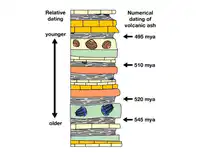
The exact age of a rock or material, representing the number of years that have passed since it formed.
Example: This diagram shows a rock column where specific layers, like volcanic ash, are assigned a numerical age (e.g., 495 million years ago).
2.
FLASHCARD QUESTION
Front
Absolute Dating Noun
[ab-so-loot day-ting]
Back
Absolute Dating
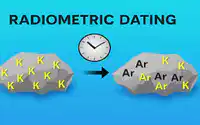
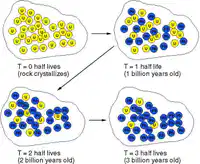
The method used to determine the actual date or age of a rock or other object, often using radioactive decay.
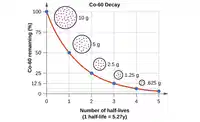
Example: This graph shows that after each half-life, the amount of a radioactive substance decreases by 50%, a principle used for absolute dating.

3.
FLASHCARD QUESTION
Front
Radioactive Decay Noun
[ray-dee-oh-ak-tiv di-kay]
Back
Radioactive Decay
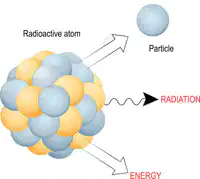
The process where an unstable atomic nucleus loses energy by emitting radiation, causing one element to change into another.
Example: A radioactive atom is unstable and releases particles and energy, a process called radioactive decay, to become more stable.
4.
FLASHCARD QUESTION
Front
Radioactive Isotope Noun
[ray-dee-oh-ak-tiv ahy-suh-tohp]
Back
Radioactive Isotope
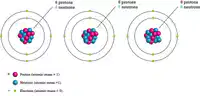
An unstable version of a chemical element that is likely to undergo radioactive decay to become more stable.
Example: This image shows isotopes of Carbon. They all have 6 protons, but different numbers of neutrons, which changes their mass and stability.
5.
FLASHCARD QUESTION
Front
Parent Isotope Noun
[pair-uhnt ahy-suh-tohp]
Back
Parent Isotope
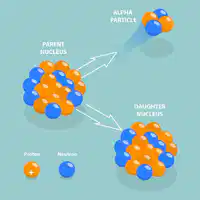
The initial radioactive isotope that undergoes decay to form a new, more stable element called a daughter isotope.
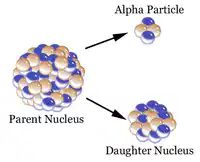
Example: The parent isotope is the original, unstable atom (shown as the 'Parent Nucleus') that decays over time into a new, more stable daughter atom.
6.
FLASHCARD QUESTION
Front
Daughter Isotope Noun
[daw-ter ahy-suh-tohp]
Back
Daughter Isotope
The stable product that results from the radioactive decay of an unstable parent isotope over a period of time.
Example: An unstable parent nucleus decays, transforming into a new, more stable daughter nucleus by releasing a particle, a process used in absolute dating.
7.
FLASHCARD QUESTION
Front
Fission Noun
[fish-uhn]
Back
Fission
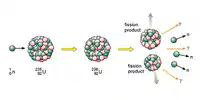
A nuclear process where an atom's nucleus splits into smaller fragments after being struck by a neutron.
Example: A neutron strikes a large nucleus (Uranium-235), causing it to split into two smaller nuclei, releasing energy and more neutrons in the process.
Access all questions and much more by creating a free account
Create resources
Host any resource
Get auto-graded reports

Continue with Google

Continue with Email

Continue with Microsoft
or continue with

%20(1).png)
Apple

Others
Already have an account?


