

Waves Review

Flashcard
•
Science
•
6th - 8th Grade
•
Practice Problem
•
Hard

Barbara White
FREE Resource
Student preview

27 questions
Show all answers
1.
FLASHCARD QUESTION
Front
Wave Noun
[wayv]
Back
Wave
A disturbance that transfers energy from one point to another without transferring matter, typically caused by a vibration.
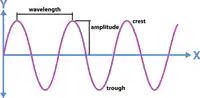
Example: This diagram shows a transverse wave, labeling its key parts: the highest point (crest), lowest point (trough), height from equilibrium (amplitude), and length.

2.
FLASHCARD QUESTION
Front
Medium Noun
[mee-dee-um]
Back
Medium
The material, such as a solid, liquid, or gas, through which a wave travels to transport its energy.
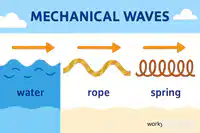
Example: Mechanical waves transfer energy by traveling through a substance, like water, a rope, or a spring, which is called the medium.
3.
FLASHCARD QUESTION
Front
Mechanical Wave Noun
[muh-kan-i-kuhl wayv]
Back
Mechanical Wave
A wave that requires a medium to travel through, transferring energy via the vibration and collision of particles.
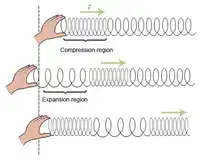
Example: A hand moving a spring up and down creates a disturbance that travels along the spring as a wave, demonstrating how mechanical waves transfer energy through a medium.

4.
FLASHCARD QUESTION
Front
Electromagnetic Wave Noun
[ih-lek-troh-mag-net-ik wayv]
Back
Electromagnetic Wave
A wave composed of vibrating electric and magnetic fields that does not require a medium and can travel through a vacuum.
Example: This diagram shows the electromagnetic spectrum, a range of waves with different wavelengths, from high-energy gamma rays to low-energy radio waves.

5.
FLASHCARD QUESTION
Front
Transverse Wave Noun
[trans-vurs wayv]
Back
Transverse Wave
A wave in which particles of the medium vibrate perpendicular, or at right angles, to the direction of wave travel.
Example: This diagram shows a transverse wave, labeling its highest point (peak), lowest point (trough), height from the center (amplitude), and length of one cycle (wavelength).

6.
FLASHCARD QUESTION
Front
Longitudinal Wave Noun
[lon-ji-too-din-uhl wayv]
Back
Longitudinal Wave
A wave in which particles of the medium vibrate back and forth, parallel to the direction of the wave's travel.
Example: A speaker creates a longitudinal wave by pushing air molecules into areas of high pressure (compression) and low pressure (rarefaction) that travel outwards.

7.
FLASHCARD QUESTION
Front
Surface Wave Noun
[sur-fis wayv]
Back
Surface Wave
A combination of a transverse and a longitudinal wave where particles of the medium move in a circular motion.
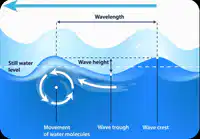
Example: This diagram shows a surface wave, where energy travels along the water's surface, causing water particles to move in a circular motion underneath.

Access all questions and much more by creating a free account
Create resources
Host any resource
Get auto-graded reports

Continue with Google

Continue with Email

Continue with Microsoft
or continue with

%20(1).png)
Apple

Others
By signing up, you agree to our Terms of Service & Privacy Policy
Already have an account?


