
3.5 Surface Area of Prisms and Cylinders

Flashcard
•
Mathematics
•
8th Grade
•
Practice Problem
•
Hard
Standards-aligned

Wayground Content
FREE Resource
Student preview

14 questions
Show all answers
1.
FLASHCARD QUESTION
Front
What is the formula for the total surface area of a rectangular prism?
Back
The total surface area (SA) of a rectangular prism is given by the formula: SA = 2lw + 2lh + 2wh, where l is the length, w is the width, and h is the height.
Tags
CCSS.7.G.B.6
2.
FLASHCARD QUESTION
Front
What is the formula for the lateral surface area of a rectangular prism?
Back
The lateral surface area (LSA) of a rectangular prism is given by the formula: LSA = 2h(l + w), where h is the height, l is the length, and w is the width.
Tags
CCSS.7.G.B.6
3.
FLASHCARD QUESTION
Front
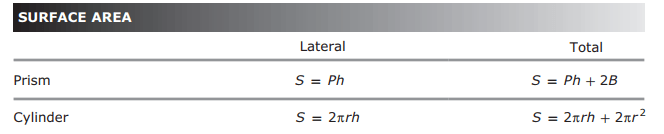
What is the formula for the total surface area of a cylinder?
Back
The total surface area (SA) of a cylinder is given by the formula: SA = 2 ext{π}r^2 + 2 ext{π}rh, where r is the radius and h is the height.
4.
FLASHCARD QUESTION
Front
What is the formula for the lateral surface area of a cylinder?
Back
The lateral surface area (LSA) of a cylinder is given by the formula: LSA = 2 ext{π}rh, where r is the radius and h is the height.
5.
FLASHCARD QUESTION
Front
If a rectangular prism has a length of 5 cm, width of 3 cm, and height of 4 cm, what is its total surface area?
Back
The total surface area is 2(5*3 + 5*4 + 3*4) = 2(15 + 20 + 12) = 2(47) = 94 cm².
Tags
CCSS.7.G.B.6
6.
FLASHCARD QUESTION
Front
Calculate the lateral surface area of a rectangular prism with dimensions 7 cm (length), 3 cm (width), and 9 cm (height).
Back
The lateral surface area is LSA = 2h(l + w) = 2*9(7 + 3) = 2*9*10 = 180 cm².
Tags
CCSS.7.G.B.6
7.
FLASHCARD QUESTION
Front
What is the total surface area of a cylinder with a radius of 4 cm and a height of 10 cm?
Back
Using the formula SA = 2 ext{π}r^2 + 2 ext{π}rh, we find SA = 2*3.14*4^2 + 2*3.14*4*10 = 100.48 + 251.2 = 351.68 cm².
Access all questions and much more by creating a free account
Create resources
Host any resource
Get auto-graded reports

Continue with Google

Continue with Email

Continue with Microsoft
or continue with

%20(1).png)
Apple

Others
By signing up, you agree to our Terms of Service & Privacy Policy
Already have an account?

